Tulsa, OK · Garage Door Service
Sand Springs runs about 7,592 households on housing built mostly around 1980 - a decade ahead of the wider service area. Here's what breaks and what we carry for it.
Sand Springs has roughly 7,592 households, which is a small enough number that the fault patterns repeat block to block instead of scattering all over a big city grid. Most of the houses we get called to here went up around 1980, a decade earlier than the median build year across the wider Tulsa service area (which runs closer to 1990). That ten-year gap matters on a garage door. Openers from that era are past their second or third motor, and the torsion springs on those original setups have usually already been swapped once by whoever owned the house before.
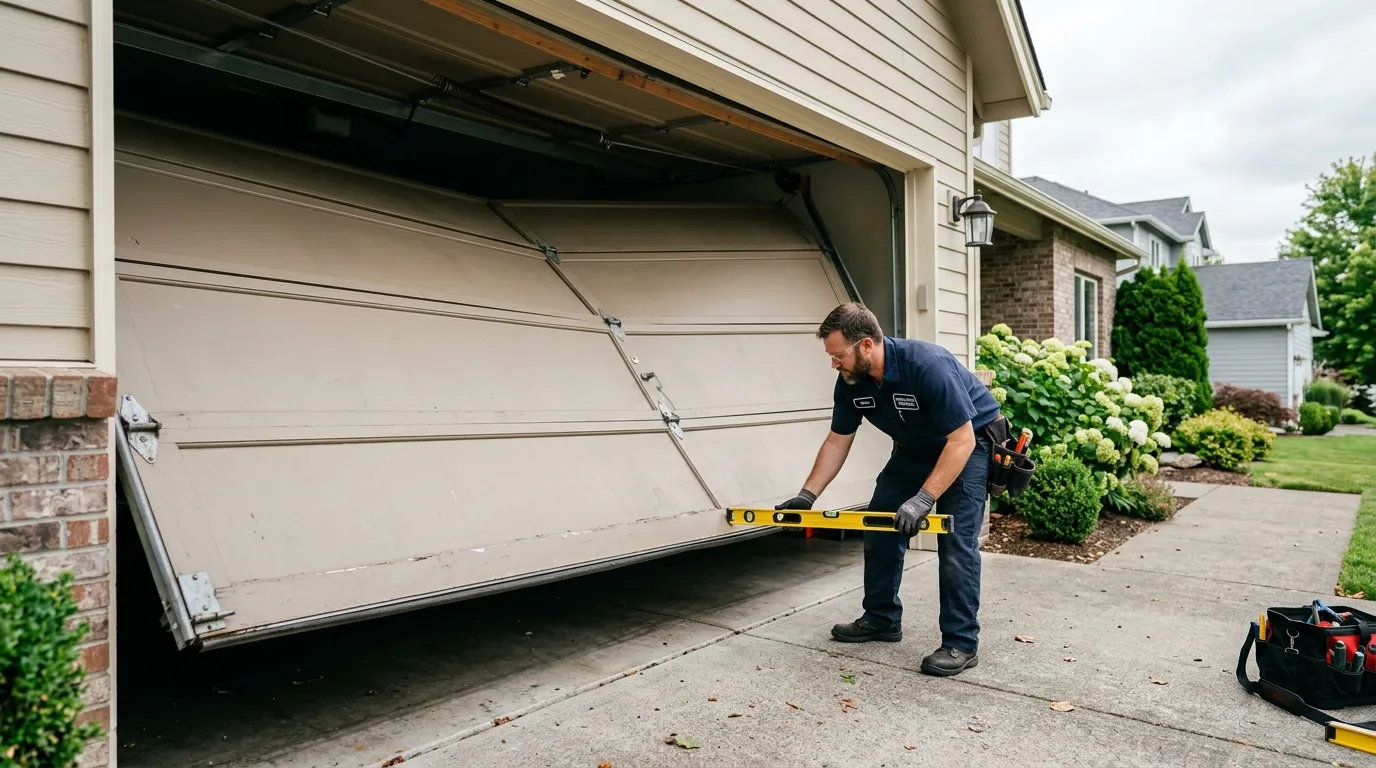
The cold-moderate climate this part of Oklahoma sits in means steel components go through real freeze-thaw cycling most winters, not the mild kind. That cycling stiffens grease in bearings, shrinks steel cable a hair each cold snap, and eventually a cable frays right where it wraps the drum. On a town this size, we see the same five or six failure points over and over: worn rollers, a snapped torsion spring, a cable coming apart at the drum, a photo-eye that quit lining up, or a panel that's taken a hit and won't seat square anymore.
Because the housing stock here clusters around 1980, the hardware sizes are predictable enough that we carry them on the truck rather than order them after we've already diagnosed the job. Standard torsion springs sized for a single or double door of that era, steel rollers, safety cables, and the photo-eye sensors that replaced the old mechanical reversing bars are all things we roll out with, not things we come back for.
Where we don't stock a part, it's usually a discontinued opener logic board or a specialty panel insert that a manufacturer stopped making years ago - those we order in, and we'll tell you straight if that's the situation before we start the clock on labor.
Sand Springs is about 13 miles from Tulsa, and we work it as a scheduled run out of Tulsa rather than a separate branch - there's no depot in Sand Springs itself, so we ask for your address up front and route the day around it. Tell us what the door is doing (won't open, stuck halfway, making a bang, opener runs but door doesn't move) and we can usually tell you over the phone whether it's a same-visit fix or a parts-order situation.
Have your garage door brand or the opener's model number ready if you can find it - it's usually on a sticker on the motor housing. That single detail saves a second trip more often than anything else we ask for.
A door that reverses right after it touches the floor is almost always the photo-eye sensors, not the spring - check first whether something's blocking the beam between the two little eyes near the bottom of the tracks. A door that's heavy to lift by hand, or that slams down fast, points to a torsion spring that's lost tension; on the 1980-era doors common here, that's usually the original spring or its first replacement, and it's not a DIY fix - torsion springs are under enough load to hurt someone.
A loud bang followed by the door refusing to move at all is the classic sign of a spring that's fully broken, not just worn. Grinding or popping from the top of the door as it travels usually means a roller's gone bad in its track, which is a cheaper fix than most people expect once you're not chasing a spring problem at the same time.
We don't have a published price list to quote here, and we're not going to make one up. What we can tell you is that Sand Springs households run a median income around $73,400, a bit above the wider service area's $72,137, which doesn't change what a job costs but does mean most of the repairs we do here are the kind homeowners pay out of pocket rather than defer for years. Cost on any given visit comes down to whether it's a spring, a cable, an opener board, or a full panel, and whether the part is one we're carrying that day or one we need to order.
One honest limitation: if a door's springs, opener, and bottom section are all failing at once on a house from this era, replacement is usually the better money than three separate repairs stacked on top of each other. We'll say so if that's what we find.
Because we run this as a Tulsa-based route rather than a local branch, the time-without-a-door question comes down mostly to parts, not distance. A torsion spring swap, roller replacement, or cable job is typically finished in one visit once we're on site, since those are the parts we stock for houses of this age. A discontinued opener board or a specialty panel changes that math, since it has to be ordered before we can finish the job.
We're not going to promise a same-day window here since we don't have a fixed response-time figure for this stop, but we can tell you what we find and what the wait looks like before we start any work that needs an ordered part.
There isn't one. Sand Springs is covered from Tulsa, about 13 miles out, as part of the wider service area. We schedule it as a routed job rather than a local drop-in, which is why we ask for your address before quoting a visit.
The housing stock here is a bit older on average - most homes went up around 1980, roughly a decade before the median build year across the rest of the service area. That means more original torsion hardware and openers that have already been through at least one replacement cycle.
For the common sizes - torsion springs, rollers, safety cables, photo-eye sensors - yes, those are stocked because they match what's common in houses of this era. Discontinued opener boards or specialty panels usually have to be ordered.
If the door is heavy to lift by hand or slams down fast, that's spring tension, not the opener. If the opener runs but the door doesn't move, or the door reverses right at the floor, that points to the drive mechanism or the photo-eye sensors instead.
Call or request a quote - tell us what your door is doing and where you are.